On September 21, 2019, guitar fireworks lit up Dallas, Texas, when rock icon Joe Walsh teamed up with his Eagles bandmate and country virtuoso Vince Gill for a blistering performance of “Rocky Mountain Way” at Eric Clapton’s Crossroads Guitar Festival.
From the moment Walsh kicked off with his unmistakable talk box intro, the crowd knew they were witnessing something extraordinary. His gritty vocals and searing guitar licks proved that decades on, his rock ‘n’ roll spirit remains as fierce as ever.
Vince Gill brought his own flavor to the stage, blending his smooth, country-infused style with Walsh’s raw, blues-driven sound. The interplay between the two was electric—Gill’s fluid solos danced effortlessly alongside Walsh’s aggressive riffs, creating a thrilling fusion of Nashville and classic rock.
Eric Clapton’s Crossroads Guitar Festival has long been a celebration of guitar mastery, and this performance was one of the evening’s most unforgettable moments. The synergy between Walsh and Gill, backed by a thunderous rhythm section, breathed new life into the 1973 classic.
As the final notes rang out, the audience erupted in applause—a testament to the timeless power of “Rocky Mountain Way” and the enduring magic of two guitar legends sharing the stage.
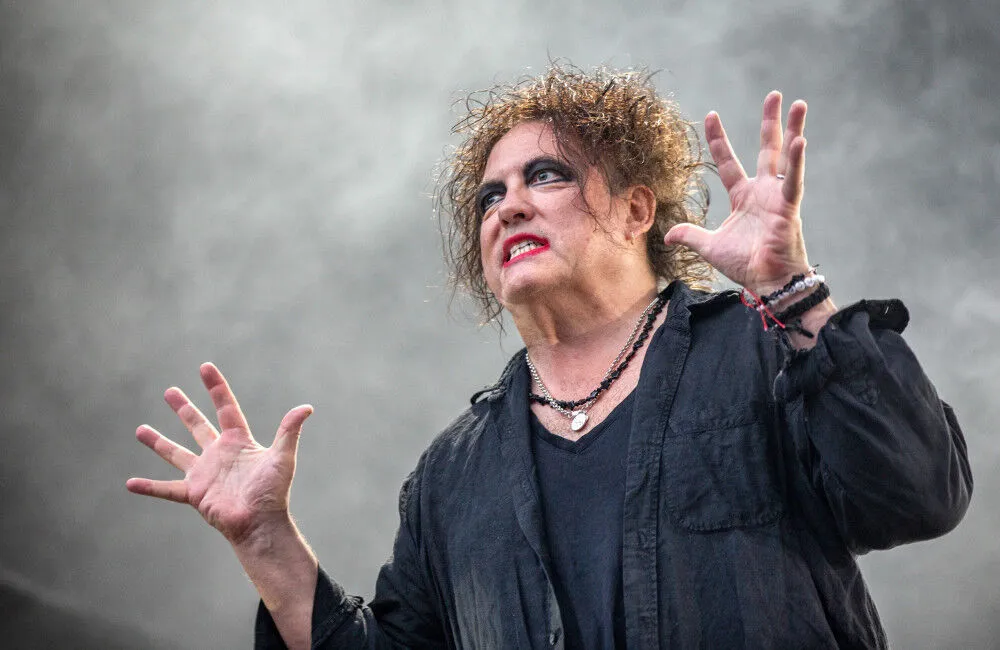
By the time The Cure took the stage at Rock am Ring in 1986, they had evolved from post-punk outsiders to festival headliners. Riding the wave of both critical acclaim and commercial success, the band remained committed to honoring their roots while continuing to push their creative boundaries.
Despite their growing fame, Robert Smith and his bandmates never lost touch with their core fans. Their refusal to become complacent—always reinventing their sound while staying true to their essence—has been a key factor in building the passionate, cult-like following that continues to support them today.
A driving force behind this enduring appeal is The Cure’s restless creativity. While the band may release music less frequently now (with fans still eagerly awaiting those promised three albums), their early years were marked by a relentless pursuit of artistic growth. This constant evolution carried them from the raw energy of post-punk to the atmospheric depths of gothic rock and, eventually, to mainstream stardom.
But before reaching those heights, they needed a breakout moment. For The Cure, that moment arrived with “A Forest.” Released in 1980 on their second album, Seventeen Seconds, the song marked a turning point. It introduced a darker, more polished sound that distinguished them from their punk beginnings and hinted at the ethereal style that would define their future work.
Since its release, “A Forest” has remained a staple of The Cure’s live performances. While the song’s haunting intensity may have softened over the years, its impact on the band’s trajectory is undeniable. In 1986, as they performed at Rock am Ring in Nürburgring, Germany, the track received a fresh makeover. With a recharged lineup—featuring Robert Smith, Lol Tolhurst, Simon Gallup, Porl Thompson, and Boris Williams—the band had recently dropped The Head on the Door, an album that propelled them to international stardom with hits like “Close to Me” and “In Between Days.”
Rather than sidelining older tracks in favor of new hits, The Cure chose to transform “A Forest” to reflect their evolving sound. The 1986 live version leaned heavily into electronic textures, with pulsating synth lines amplified and Smith’s guitar delivering a grittier punch. This updated take on the song mirrored the band’s creative spirit—always adapting, never standing still.
The Cure’s ability to evolve while preserving their identity has been crucial to their four-decade reign in the music world. And if their ongoing commitment to reinvention is any indication, we might still be hearing “A Forest” echoing through festival grounds for years to come.
Check out The Cure’s electrifying performance of “A Forest” from Rock am Ring 1986—a perfect snapshot of a band in constant motion.
A star-studded roster of rock icons united to honor Ozzy Osbourne during the 2024 Rock & Roll Hall of Fame induction ceremony. With an elite backing band, the tribute showcased musicians who share a rich history with Osbourne, including Red Hot Chili Peppers drummer Chad Smith, Metallica bassist Robert Trujillo, multi-instrumentalist Andrew Watt, and keyboardist Adam Wakeman. These collaborators, who contributed to albums like Ordinary Man and Patient Number 9, infused the performance with both nostalgia and raw energy, creating a memorable celebration.
Maynard James Keenan and Wolfgang Van Halen Light Up “Crazy Train”The homage kicked off with an electrifying rendition of Ozzy’s 1980 hit “Crazy Train.” Osbourne’s iconic call of “All aboard!” set the stage before Tool’s Maynard James Keenan took the mic to deliver the vocals. Adding to the excitement, Wolfgang Van Halen joined the performance, injecting his signature flair and amplifying the night’s energy.
Zakk Wylde and Jelly Roll Bring Heart to “Mama, I’m Coming Home”Longtime guitarist Zakk Wylde, a fixture of Osbourne’s solo career, took center stage alongside country sensation Jelly Roll for an emotional performance of “Mama, I’m Coming Home.” The heartfelt ballad from 1991, which remains Ozzy’s sole Top 40 hit, highlighted his musical range and the powerful connection between him and his collaborators.
Billy Idol and Steve Stevens Close with “No More Tears”The grand finale featured a powerhouse take on “No More Tears,” with rock legend Billy Idol and his iconic guitarist Steve Stevens joining the festivities. Idol, who shares a close friendship with Osbourne, brought his trademark swagger to the stage. In the weeks leading up to the event, Ozzy openly advocated for Idol’s induction into the Rock Hall, declaring, “Billy Idol is a rock legend. His music is timeless. It’s about time he gets inducted.”
This epic tribute marked Ozzy Osbourne’s second induction into the Rock & Roll Hall of Fame, following his 2006 recognition as a member of Black Sabbath. The night not only celebrated his monumental career but also underscored his enduring influence on the world of rock music.
Billy Joel and Paul McCartney—two of rock n’ roll’s most iconic figures—shared the stage for an unforgettable performance. The historic moment took place at Shea Stadium in New York, the former home of the New York Mets baseball team, as part of the venue’s farewell concert.
The crowd erupted with excitement as the two legends joined forces to perform The Beatles’ classic “I Saw Her Standing There.” Their energetic duet not only honored the stadium’s legacy but also showcased the enduring magic of their music.
Fans were left in awe by the once-in-a-lifetime collaboration. “It was like watching rock n’ roll history unfold before our eyes,” one attendee said. Another added, “Seeing Billy and Paul together was pure magic—an unforgettable moment.”
In a small guitar shop, an elderly man quietly picks up a guitar, and within moments, the store is filled with the soul-stirring sound of his music. With his eyes closed, he plays with a grace that reflects decades of experience, as if each note carries a memory from his past. The simple act transforms the shop into a stage, capturing the attention of everyone present.
Customers pause mid-conversation, drawn to the beauty of his playing. His fingers move effortlessly, weaving a melody that bridges generations and brings a sense of unity among the listeners. The atmosphere shifts as the shop becomes a shared space of musical magic.
As the last note fades, a hush lingers. The elderly man gently places the guitar back and acknowledges the silent admiration with a humble nod. Without fanfare, he leaves the shop—but the music and the memory of his extraordinary performance remain, leaving a lasting impression on all who witnessed it.
Phil Collins and Mike Rutherford of Genesis recently reunited on stage for the first time in over a decade, delivering a special moment for fans. Watch the clip below.
The last time the two shared a stage was during the 2007 Genesis reunion tour, which celebrated the band’s 40th anniversary.
During Collins’ solo concert in Berlin on June 7, the audience was treated to an unexpected reunion when Rutherford joined him to perform “Follow You Follow Me.” The beloved 1978 single was the lead track from Genesis’ ninth studio album, ‘…And Then There Were Three….’
In fan-captured footage, Rutherford greets Collins with a warm hug before picking up an acoustic guitar. As the crowd erupts into cheers, Collins playfully introduces his former bandmate, saying, “I think we’ll have it one more time – Mr. Mike Rutherford!”
Fans were thrilled to see the two legends together again. “This is pure nostalgia. Genesis isn’t done yet,” one fan wrote. Another added, “A huge and emotional moment.”
Earlier in the evening, Rutherford had performed with his band Mike + The Mechanics, who are currently supporting Collins on his solo tour.
Meanwhile, across the music world, another legendary reunion was taking place. On March 24, Robert Plant joined Roger Daltrey on stage at the Royal Albert Hall in London to deliver a stirring rendition of The Who’s “Baba O’Riley.” Sharing the stage with Eddie Vedder, Glen Hansard, Kelly Jones, and Simon Townshend, the performance marked the grand finale of the Ovation concert series benefiting the Teenage Cancer Trust—Daltrey’s final time curating the event.
Before the performance, Plant paid a heartfelt tribute to Daltrey. “The purpose of this regime that you’ve created is spectacular,” he said. Reflecting on their early days, Plant recalled, “I was 16 years old, watching this monster group. I saw you, this golden god, and thought, ‘How do you do that?'”
He continued, “We’ve crossed paths so many times through the years. I was at the first ‘Tommy’ performance at Fillmore East, and I ate all your sandwiches while you worked. I’m just grateful to be here.”
Both Genesis and The Who’s legendary members continue to captivate audiences, hinting that their musical legacies are far from over.
Phil Collins and Mike Rutherford of Genesis recently reunited on stage for the first time in over a decade, delivering a special moment for fans. Watch the clip below.
The last time the two shared a stage was during the 2007 Genesis reunion tour, which celebrated the band’s 40th anniversary.
During Collins’ solo concert in Berlin on June 7, the audience was treated to an unexpected reunion when Rutherford joined him to perform “Follow You Follow Me.” The beloved 1978 single was the lead track from Genesis’ ninth studio album, ‘…And Then There Were Three….’
In fan-captured footage, Rutherford greets Collins with a warm hug before picking up an acoustic guitar. As the crowd erupts into cheers, Collins playfully introduces his former bandmate, saying, “I think we’ll have it one more time – Mr. Mike Rutherford!”
Fans were thrilled to see the two legends together again. “This is pure nostalgia. Genesis isn’t done yet,” one fan wrote. Another added, “A huge and emotional moment.”
Earlier in the evening, Rutherford had performed with his band Mike + The Mechanics, who are currently supporting Collins on his solo tour.
In a 2018 interview, Collins expressed openness to a Genesis reunion, suggesting that his son Nic could take over drumming duties. “I quietly mentioned to Tony [Banks, Genesis keyboardist] that if we did anything again, it would be with Nic on drums,” Collins revealed. “He didn’t exactly say no—or maybe he didn’t hear me.”
Both Collins and Rutherford have hinted at the possibility of bringing Genesis back together, and Tony Banks has further fueled speculation by refusing to rule out a future reunion.
Over the years, many musicians have paid homage to the legendary John Lennon through their music. In 2012, Bob Dylan joined their ranks with his heartfelt tribute, “Roll On, John.” Long before Lennon’s tragic death on December 8, 1980, he and Dylan shared a parallel journey as contemporaries in the music scene. Dylan even introduced The Beatles to marijuana, and Lennon acknowledged Dylan by name in “God” from his first solo album after leaving the band.
Nearly thirty years after Lennon’s passing, Dylan took a quiet, unpublicized visit to the former Beatle’s childhood home. With his understated appearance and the passage of time as a disguise, Dylan blended seamlessly with other tourists. This visit planted the seeds for the emotional, eight-verse tribute that would later become “Roll On, John.”
During a European tour in 2009, Dylan used a rare day off to explore Lennon’s childhood residence in Woolton, Liverpool. He joined a small group of 13 visitors on a National Trust minibus tour, which showcased the house restored to its 1940s condition and featuring early Lennon memorabilia. According to a National Trust spokesperson, Dylan went completely unrecognized by his fellow tourists.
Reflecting on Lennon’s formative years, Dylan was particularly struck by the imagery in “Strawberry Fields Forever.” “He used to hang out in the park behind his house,” Dylan said. “In Britain, there’s all this history of hangings, and that line—’Nothing to get hung about’—always puzzled me. I realized he meant it literally: ‘Don’t worry, Mum, there’s nothing they’re going to hang me for.’ That kind of detail fascinated me.”
While The Beatles and Dylan experienced massive success during the 1960s, there was also an undercurrent of competition as both acts dominated the global charts. Despite this rivalry, Dylan always felt a personal connection to Lennon. “John came from the northern regions of Britain, the hinterlands, just like I did in America,” Dylan shared with Rolling Stone in 2012. “We both grew up in tough environments where the odds were stacked against us.”
He elaborated on their shared struggles, saying, “We were the same age, exposed to the same cultural influences, and faced similar challenges. Our paths crossed at a pivotal time, and we understood the difficulties each of us endured. I wish he were still here. There’s so much we could talk about now.”
“Roll On, John” chronicles Lennon’s life journey—from his early days in Liverpool to his final moments in New York City. Dylan skillfully weaves references to iconic Beatles lyrics, including “Come together right now over me” from “Come Together” and “I heard the news today, oh boy” from “A Day in the Life.” When asked about crafting the tribute, Dylan humbly remarked, “A person’s life is so vast—there’s endless material to draw from. I simply chose the parts I felt connected to and understood.
Rod Stewart is no stranger to surprise performances, but one lucky couple experienced a moment they’ll never forget. Andrew Aitchison and his fiancée Sharon Cook from Liverpool, UK, had their dream Las Vegas wedding hanging by a thread after their travel company, Thomas Cook, went bankrupt. Just when it seemed everything was falling apart, Delta Airlines and Caesars Palace stepped in to save the day.
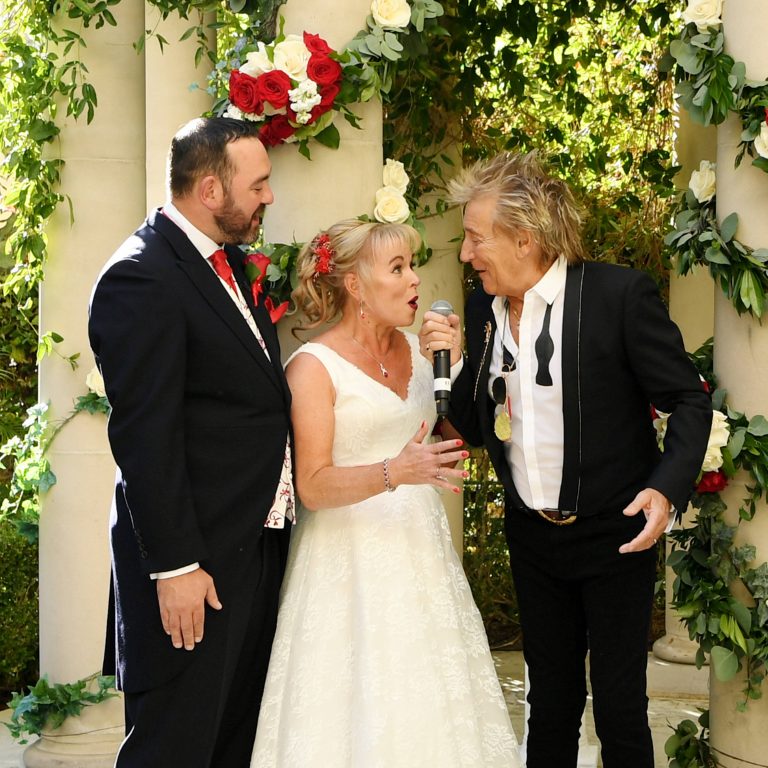
Thanks to their generosity, the couple—and their loved ones—made it to Vegas to celebrate. But the biggest surprise came moments after they said, “I do.” To their shock, Sir Rod Stewart appeared, microphone in hand, to wish them a lifetime of happiness. Without missing a beat, he serenaded the newlyweds with a heartfelt rendition of “Have I Told You Lately That I Love You.”
Reflecting on the unforgettable moment, Andrew admitted they were still in disbelief, calling Rod a “legend.” Sharon described the singer as “wonderful” and said his appearance made her feel truly special.
What began as a heartbreaking setback turned into a magical celebration, with Rod Stewart’s surprise serenade serving as the perfect finishing touch. A special thanks to Delta Airlines, Caesars Palace, and Sir Rod Stewart for turning disappointment into a dream come true.
At the Desert Trip festival, Paul McCartney surprised fans by bringing out a special guest—pop superstar Rihanna. The duo performed their 2015 hit “FourFiveSeconds,” which originally featured Kanye West, though he was absent from the stage.
Midway through his set, nestled between the Beatles classics “Lady Madonna” and “Eleanor Rigby,” McCartney introduced Rihanna with a playful remark: “We finally found somebody under the age of 50!” His comment highlighted the festival’s lineup of rock legends, including Bob Dylan, the Rolling Stones, Neil Young, Roger Waters, and The Who.
McCartney’s performance was packed with iconic Beatles hits, reflecting the festival’s focus on timeless classics. Even Dylan, fresh off winning the Nobel Prize for Literature, stuck to his ’60s material—marking the first time in four years he played guitar onstage.
“It’s a once-in-a-lifetime thing,” McCartney told the crowd. “Or for us, twice in a lifetime,” he joked, referencing the festival’s two-weekend format where all artists performed twice.
The surprise appearance of Rihanna added a fresh twist to a nostalgic night, creating an unforgettable festival moment for fans.