
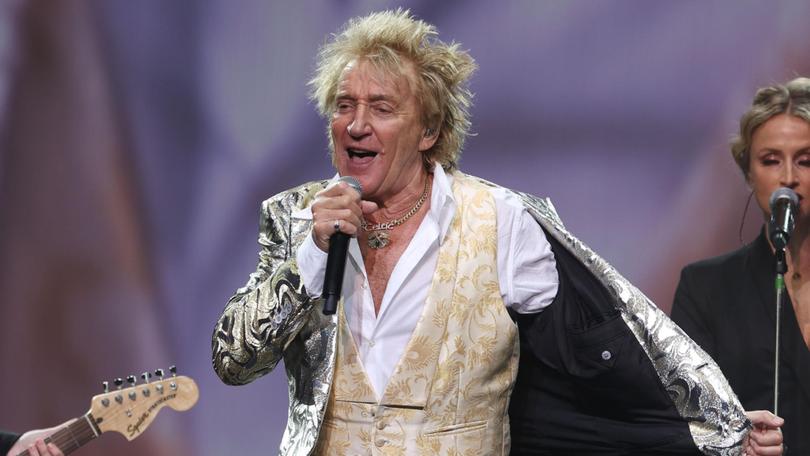
Some songs are so emotionally recognizable that hearing them performed in a different style can feel like discovering them all over again. Bonnie Tyler’s “It’s a Heartache” is one of those songs. Originally released in 1977 and becoming a major international hit in 1978, the heartbreak anthem was defined by Tyler’s gritty, unmistakable voice and the raw emotion she brought to every line. Decades later, Rod Stewart and Michael Bublé gave the song a completely different personality.
Their version appeared on Rod Stewart’s 2006 album Still the Same… Great Rock Classics of Our Time, a collection that found the legendary singer revisiting some of the classic songs that had influenced his musical journey. Among the album’s familiar rock and pop standards, “It’s a Heartache” stood out as an especially interesting choice because it allowed Stewart to revisit a song strongly associated with another distinctive voice.
The addition of Michael Bublé made the recording even more intriguing. By the mid-2000s, Bublé had established himself as one of the leading modern interpreters of traditional pop and jazz standards. His smooth delivery, relaxed phrasing and classic crooner style seemed almost tailor-made for a collaboration with Stewart, whose career had always moved comfortably between rock, pop, soul and traditional standards.
Instead of attempting to recreate Bonnie Tyler’s original performance, Stewart and Bublé approached the song from a more polished and sophisticated angle. The result feels less like a dramatic rock ballad and more like an elegant late-night performance. Bublé’s velvety tone brings warmth to the melody, while Stewart’s instantly recognizable raspy voice adds character and emotional weight.
That contrast between their voices is arguably the most fascinating part of the recording. Bublé represents a newer generation of classic-style singers, while Stewart carries decades of rock-and-roll history in his voice. Their vocal personalities are completely different, yet they complement one another remarkably well.
The arrangement also helps transform the song. “It’s a Heartache” was originally built around the emotional directness of Tyler’s performance, but Stewart and Bublé give it a smoother, more restrained atmosphere. The song still carries its familiar sense of heartbreak, but the presentation feels more mature and intimate.
For listeners familiar with Tyler’s original, the contrast is especially noticeable. Her version has an unmistakable late-1970s energy, driven by her powerful delivery and emotional intensity. Stewart and Bublé, meanwhile, seem less interested in raw vocal force and more focused on phrasing, chemistry and atmosphere.
There is also something fitting about Stewart recording the song. Throughout his career, he has demonstrated an unusual ability to move between musical worlds. From his early rock work to soul-inspired recordings and later standards, Stewart has repeatedly shown that his voice can give familiar material a distinctive identity.
Bublé brings another layer to that musical tradition. His career has been built largely around making older styles feel contemporary without stripping away their original character. His presence alongside Stewart creates a bridge between generations of popular music.
What makes their “It’s a Heartache” memorable isn’t simply the fact that two famous singers performed it together. It is the way their contrasting styles reshape the emotional character of the song. The heartbreak remains, but the mood changes—from raw and fiery to smooth, polished and almost lounge-like.
Ultimately, the recording is a reminder that great songs are remarkably adaptable. A melody written decades earlier can sound completely different when placed in the hands of new performers, yet still retain the emotional core that made it memorable in the first place.
Bonnie Tyler gave “It’s a Heartache” its original identity. Rod Stewart and Michael Bublé offered another interpretation—one built on elegance, vocal contrast and timeless crooner charm. More than simply revisiting an old hit, their collaboration demonstrates how two distinctive voices can breathe new life into a familiar classic.
